Monday, April 4, 2016
Digrassi His True Art of Defense - The Sword and Round Target Part 2
Foreword by Dwight
Protect yourself from evil 16th century fencing a-holes! The great Italian Digrassi provides a wealth of information to offset any issues that you may have with these ruffians of the past. His journey takes us to part 2 of the sword and round shield. If you haven't read or listened to the past sections go ahead and catch up!
The Defense of the High Ward at Sword and Round Target
For the defending of the thrust of the high ward, it is most sure standing at the low ward, and to endeavor to overcome the enemy, by the same skill by the which he himself would obtain the victory. In the very same time, that he delivereth his thrust, a man must suddenly increase a slope pace with the left foot, beating of the enemies Target with his own and driving of a thrust perforce with the increase of a pace of the right foot. And with this manner of defense being done with such nimbleness as is required, he doth also safely strike the enemy, who cannot strike him again, because by means of the said slope pace he is carried out of the line in the which the enemy pretended to strike.
The Hurt of the Broad Ward at Sword and Round Target
It is very difficult to strike in this broad ward, if first with much compassing and gathering of the enemy, a man do not affair with the circumference of his Target near his hand, to beat off the enemy's sword. And being so beaten, to increase a left pace and further by adding there unto the increase of a pace of the right foot, to discharge a thrust. But it shall happily be better in the handling of these weapons, not to use this broad ward: for the hand is born out of the straight line, in the which he may strike both safely and readily: and before it return into the said line, there is much time spent.
And further, a man is not then in case with his Target to beat off the enemy's sword: But if happily he be, yet (though he be very ready, as well with the hand as foot) his thrust shall never enter so far that it may hit home: For the enemy, with a very small motion of this Target forwards, may very easily drive the enemy's sword out of the straight line. Therefore, he that would change or shift out of this ward, to the intent to strike, must of necessity be passing nimble and ready, and before he delivereth his blow, must beat the enemy's sword with his Target.
The Defense of the Broad Ward at Sword and Round Target
Because in every occasion or accident a man standeth safe in the low ward, I will endeavor in this case, to place him also in the same ward, for the encountering of the hurt of the broad ward. That therefore which by mine advice he shall do, is that he take great heed, not to suffer his sword to be beaten off any manner of way. And when the enemy without this beating presumeth to enter, he must in the self-same time increase a left pace and safely deliver a thrust underneath with the increase of the right foot. And further, when the enemy shall perform, that is, first, find the sword and beat it off, (seeing of necessity if he would enter and hit home, his sword must pass by circumference of the Target near the hand) then, to withstand the entry, it is requisite that he drive the enemy's sword outwards on the right side with his Target and with the increase of the said pace, that he enter and strike him.
The Hurt of the Low Ward at Sword and Round Target
A man may strike in this ward, the right foot being behind, and before and in both ways, he may bear his sword either within or without. If therefore he find himself to stand with the right foot behind without, he shall say at any hand, before he determine to strike, to find the enemy's sword with his own, and as soon as he finds it shall clap to his Target, and strike perforce with a low thrust, increasing with the right foot. But finding himself to stand within, no more with his sword, then he doth with this Target, he shall prove whether he can find the enemy's sword and having found it, shall strain it fast between his own sword and Target, and then shall deliver a thrust with the increase of a pace of the right foot, the whcih thrust of force speedeth: This being performed, he shall settle himself in this, or in either of these ways in the low ward with the right foot before. And as he so standeth in this ward, he may after the same sort strike either within or without.
Therefore finding himself within, he shall provide to meet with the enemy's sword, and with the increase of a pace of the right foot. And finding himself to bare his sword within the said ward, and with his right foot behind, he shall endeavor to find the enemy's sword with the Target, and having found it, shall close it in between his own sword and Target, and with the increase of a left pace, shall perforce hurt the enemy, with the increase of a pace of the right foot.
Now, all these thrusts, no doubt shall speed every time that the enemy either maketh no traverse motion with his body, either as he striketh, commeth directly forwards, or else being fearful, goeth directly backwards, for it is not possible that one man go to fast directly backwards, as another may forwards. Yet is therefore diligently to be observed in this ward, never to determine to strike, either in the handling of these, or of any other kind of weapons, if (with one of them) he shall not first find the enemy's sword. The which redowneth to the great profit of every man, but especially of those, who have strong arms, for that they are the better able to beat back the enemy's weapon.
Of the Defense of the Low Ward at Sword and Round Target
All the foresaid thrusts are warded, by not suffering the sword to be found by the enemy with either of his weapons. For the enemy (not finding it, will not allure himself, or presume to enter, without first finding of the sword) may most easily be stroken and not strike, if a man increase a slope pace, (to the end he may void his body from hurt) and with the increase of a straight pace of the right foot, do also discharge a thrust beneath. And after this order he may strike safely, (not only when his sword is not found by the enemy, but also when it chanceth to be found) if he be ready and nimble to make his slope pace, and to beat off, as forcible as he may, the enemy's target with his own sword and target, thereby forcing a low thrust to enter in , with the increase of a pace with the right foot. And thus much concerning the true striking and defending of the sword and round Target.
Musings
It is unfortunate that you do not see many people carrying shields anymore. I believe the only shields used today are the riot and ballistic shields used by law enforcement and the military. In the next section, we will look at a Case of Rapiers.
References:
"Shields: History and Terminology." Shields: History and Terminology. Pitt Rivers Museum. Web. 18 Oct. 2015. http://www.prm.ox.ac.uk/Kent/shieweap/shgenex3.html
Digrassi, Giacomo. "His True Art of Defence." University of Massachusetts and Raymond J. Lord. Web. 18 Oct. 2015. http://www.umass.edu/renaissance/lord/pdfs/DiGrassi_1594.pdf
Thursday, March 17, 2016
Donovan's The Roosevelt that I know Part 5
Foreword by Dwight
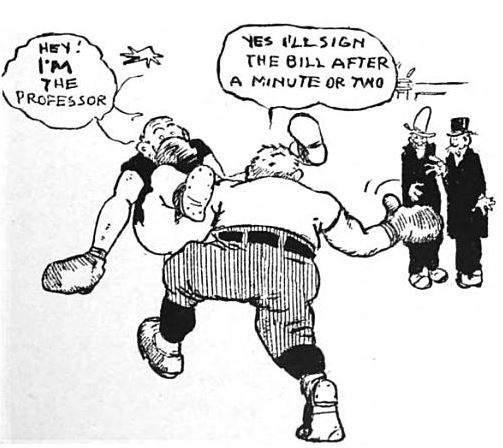
Would you spar with President of the United States? Well that is exactly what Professor Mike Donovan did in the late 1800s. He wrote a book about his experience in 1909, titled "The Roosevelt That I know". Mike Donovan was considered one of the best practitioners of the sweet science at the time. This section continues with the perspective of Mrs. Carew.
Parries a Delicate One
"What sort of a boxer is President Roosevelt?" I Inquired. Professor "Mike" cocked a blue eye at me, wrinkled up his scarred forehead and said: "Did you ever hear Capt. Jack recite that great poem of his, 'Where the Hand of God is Seen'? No? Oh, Capt. Jack, will you oblige with 'Where the Hand of God is Seen'?" Capt. Jack, nothing loath, obliged with "Where the Hand of God is Seen," and for some time thereafter nothing was said about the President.
But after a while I induced Capt. Jack to entertain the Scientist, the Boy and the Chaperon with the story of his life, including his opinion of Buffalo Bill and the evils of cigarette smoking, and I drew the Professor away. He looked alarmed. "Did you ever hear anybody like Capt. Jack?" he said. "Did you ever hear such lovely sentiments, ma'am? By golly! I'd give anything to have his talent. He can talk right ahead without stopping for two hours. I never heard such language!"
Gently but firmly I detached his attention from Capt. Jack and directed it toward the President of the United States, and when I made it clear that I was not going to try to pump him about Mr. Roosevelt's letters to him or his projected engagement at the White House, he was greatly relieved and didn't mind saying everything else that was in his heart.
"But it makes me feel bad, those letters being told about in the papers," he said. "However, the President knows me, and he will know I didn't do it intentionally.. I wouldn't have told the newspaper boys about it for the world. You've no idea what a nice man the President is. He's the kindest, best, truest man I ever met. Oh, I've known him and boxed with him a long time. He calls me 'Mike,' and we're great friends." "Well, you don't really mind if I repeat all the nice things you say about him?"
"Oh, no; not a bit. I couldn't say too many nice things about him." "Is he a hard hitter?" "Oh, my golly! yes. He comes right at you hot and heavy. And strong - why, he's got an arm as hard as a rock!" "Is he a good tempered boxer?" "Oh, golly! yes. He wouldn't be such a good boxer if he wasn't good tempered. Why, he's a happy man. He was born with that smile."
The Professor set his teeth and peeled his lips in an imitation of the much caricatured Roosevelt grin. "He was born with it, and he's got it in his heart. No matter what happens, that smile is there. I tell you, he's a happy man."
Musings
As we continue to explore Donovan's book, it reveals the incredible aspect that martial arts brings to the ego and mind. If you notice both Donovan and Roosevelt treat each other with vast respect and don't tend to gloat about their boxing abilities. Since, they were both older at this point in time, experience probably taught them to let go that ego. Carl Jung once said, "Midlife is the time to let go of an over dominant ego and to contemplate the deeper significance of human existence." I am not saying that either Donovan or Roosevelt got deeper into level of human existence, but it looks as if they shrugged off their egos and just had a great time boxing. I believe we could all learn from that.
References:
Donovan, Michael Joseph. The Roosevelt That I Know; Ten Years of Boxing with the President--and Other Memories of Famous Fighting Men,. New York: B.W. Dodge, 1909. https://books.google.com/books?hl=en&lr=&id=x7QaAAAAYAAJ&oi=fnd&pg=PA8&dq=boxing&ots=MYv8NVrKwf&sig=N21fmrbbSTU8P3S0scqcxphbg9M
Wednesday, February 17, 2016
Digrassi His True Art of Defense - The Sword and Round Target Part 1
Foreword by Dwight
Protect yourself from evil 16th century fencing a-holes! The great Italian Digrassi provides a wealth of information to offset any issues that you may have with these ruffians of the past. His journey takes us from using the square shield and transitioning to this section on the round shield. If you haven't read or listened to the past sections go ahead and catch up!
(corresponding cast)
Of the Sword and Round Target Part 1
The round target would require a long and a most exquisite consideration because it is of circular form, most capable, and most perfect of all others. But for that my purpose in this my work, is to write that only which I know doth appertain to this Art, giving leave to every man to bully himself in his own profession. And leaving a great part of this consideration to the mathematicians and historiographers to reason of his diverse qualities or passions, either who was inventor thereof, either, whether it be a weapon of antiquity or of this our rage, and coming to discourse of that, wherein it profiteth in this our time, (being a weapon so greatly honored and esteemed of Princes, Lords, and Gentlemen, that besides the use there of in their affairs, as well by day as by night, they also keep their houses richly decked and beautified therewith) and considering only that thing, in the round target, among all other weapons which may either profit or hurt in the handling thereof, I say, that the said round Target hath been diversely holden, born and used, by diverse men in diverse ages, as well as the other square target and other weapons of defense, as well as of offense. And there want not also men in our time, who to the intent they be not wearied, bare it leaning on their thigh as though that in this exercise (in which only travel and pains are available) a man should only care for rest and quietness. For by means of these two, strength and activities, (Parts in the exercise of weapons, both important and necessary) are obtained and gotten.
Other some, holding their whole arm bowed together, have carried it altogether flat against their body, not regarding either to ward their belly or utterly to lose the fight of the enemy, but will at any hand stand (as they think) safe behind it, as behind a wall, not knowing what a matter of weight it is, both to see the enemy, and work other effects, which, (by so holding it) may not be brought to pass.
Of the Manner How to Hold the Round Target
If a man would so bare the round Target, that it may cover the whole body, and yet nothing hinder him from seeing his enemy, which is a matter of great importance, it is requisite, that he bare it towards the enemy, not with the convex or outward part thereof, altogether equal, plain or even, neither to hold his arm so bowed, that in his elbow there be made (if not a sharp yet) at least a straight corner. For besides that (by so holding it) it wearith the arm: it likewise so hindereth the sight, that if he would see his enemy from the breast downwards, of necessity he must either bare his target, or bare his head so peeping forwards, that it may be sooner hurt than the target may come to ward it. And further it so defendeth, that only so much of the body is warded, as the Target is big, or little more, because it cannot move the half arm, from the elbow to the shoulder, which is very little, as every man knoweth or may perceive: So that the head shall be warded with great pain, and the thighs shall altogether remain discovered, in such sort, that to save the belly, he shall leave all the rest of the body in jeopardy. Therefore, if he would so hold the said Target, that it may well defend all that part of the body, which is from the knee upwards, and that he may see his enemy, it is requisite that he bare his arm, if not right, yet at least bowed so little, that in the elbow there be framed so blunt an angle or corner, that his eye beams parsing near that part of the circumference of the target, which is near his hand, may see his enemy form the head to the foot, and by holding the said convex part in this manner, it shall ward all the left side, and the circumference near the hand shall with the least motion defend all the right side, the head and the thighs. And in this manner he shall keep his enemy in sight and defend all that part of the body, which is allotted unto the said target. Therefore the said target shall be born, the arm in a manner so straight towards the left side, that the eyesight may pass to behold the enemy without moving, for this only occasion, either the head, or the target.
The Hurt of the High Ward at Sword and Round Target
Because the round target containeth in it most great and sure defense, therefore ought not any edgeblow which may be easily warded with the single sword without the help of the Target be delivered. Thrusts also enter very difficulty to strike the body, because the target, by means of the least motion that is seemeth to be, as it were a wall before the body. And to thrust at the leg is no sure play. That which remaineth to be done is, to thrust forcibly with the sword: and when one perceiveth, that the point there of is entered within the circumference of the enemy's target, it is necessary that he increase a left pace, and with the circumference of his own Target, to beat off enemy's sword and target, to the end it suffer the thrust so given of force to enter in. And (having so beaten and entered) to continue on the thrust in the straight line, with the increase of a pace of the right foot.
When he findeth himself in the high war, he shall increase a half pace with the hinderfoot, gathering upon the enemy, as near as he may without danger. And being so nigh that he may drive his sword within the circumference, then as soon as he perceiveth his sword to be within it, (his arm being stretched out at the uttermost length) he ought suddenly to increase a left pace, beating off with the circumference of his own target, the enemy's target: and with this increase of a pace of the right foot, to cause his thrust to enter perforce. This also he may practice when the enemy endeavoreth, to withstand the entrance of the thrust, when it is already past, within the circumference of his target.
But if the enemy (as it may fall out) ward this thrust not with that part of the circumference, which is near his hand, but with that which is above it (by means where of his target discovereth his eyes) then he may very commodiously, increasing his paces as aforesaid, recover his thrust above, and force it underneath, with the increase of a pace of the right foot. And this is a more sure way of thrusting than any other.
Musings
The round shield seems a bit more conventional compared to the square shield or target. Again Digrassi focuses on not blocking your line of sight and it would appear far easier to keep your opponent in front of you and react better with a round shield. I believe the curvature of the round shield would allow the user to ward off attacks with minimal movement as well. I feel that carrying the square shield is much like trying to carry a crappy old barn door. The second part again that Digrassi really emphasizes in every section is foot work. moving in and out left and right of the circumference.
-Dwight
References:
"Shields: History and Terminology." Shields: History and Terminology. Pitt Rivers Museum. Web. 18 Oct. 2015. http://www.prm.ox.ac.uk/Kent/shieweap/shgenex3.html
Digrassi, Giacomo. "His True Art of Defence." University of Massachusetts and Raymond J. Lord. Web. 18 Oct. 2015. http://www.umass.edu/renaissance/lord/pdfs/DiGrassi_1594.pdf
Wednesday, February 10, 2016
Donovan's The Roosevelt That I know Part 4
Foreword
by Dwight
Damn, Roosevelt has a
strong chin! Would you spar with President of the United States? Well that is exactly what Professor Mike Donovan
did in the late 1800s. He wrote a book about his experience in 1909, titled
"The Roosevelt That I know". Mike Donovan was considered one of the
best practitioners at the time. This section continues with the
perspective of Mrs. Carew.
The
Roosevelt That I know Part 4
He
went on to tell how his brother Jerry, who seems to have been a
famous fighter
before him, tried to discourage him from exercising this inborn tendency, and
gave him many a thrashing for fighting other small boys, and made him very sore
at heart, as well as elsewhere, until one day somebody remonstrated with Jerry,
saying, “Jerry, what makes you at so mean to that kid? He'll grow up and be a
credit to you if you treat him right, but if you go on pounding him like that,
people will think you're afraid of his cutting you out some day.” After which
the Sparten Jerry ceased from troubling, and the infant Mike made prodigious
strides in the art of fighting. The scientist questioned him about his first
fight, and how he felt over it. “Golly! I was the proudest thing you ever saw!”
exclaimed the Professor. “Did you win?” “No, I lost on a foul, but it wasn't my
fault.
You
see, I didn't know the rules properly, and when the other fellow kept
dropping
on his knees to escape punishment it made me mad, and I just picked him up and
walloped him good, like this” - and the Professor threw his arm around an
imaginary neck, dragged an imaginary head up to the level of his hip and
bombarded an imaginary face with his left.
There
were more reminiscences of Fistiana, and I wish I had time to repeat
some of
them. And there were learned disquisitions on the finer points of the art and
on the comparative advantages of globes and bare knuckles. Briefly, a more
cutting blow can be delivered with the knuckles, but a harder and perhaps more
damaging one with a glove, because the hand is protected from injury, and a man
accustomed to boxing with gloves is in great danger of disabling his hands if
he become involved in an impromptu fight with bare hands, because his tendency
will be to strike recklessly hard.
Moreover,
Professor Donovan's experience goes to show that a boxer's
training hampers him
in a street fight, because he instinctively observes the rules of fair play,
greatly to his own detriment. There was a story illustrating this and I wish I
had time to tell it in his own words. He was set upon by a gang of roughs while
walking home from the New York Athletic Club, and having spent the day sparring
with young stockbrokers and the like, he was very tired.
“Golly!
I was tired,” he said. “I was so tired that I walked along with my shoulders
bent like an old man.”
I
could imagine what he looked like a nice, venerable little old gentlemen
dragging himself home to a supper of gruel and dry toast. No feminine pen could
do justice to that Homeric combat. Not that Professor Donovan narrated it
Homerically. He was strictly technical, but one could read between the lines
that it was a showy affair. I forget how many men in buckram there were, but
our Professor had knocked down a few of them and never thought of kicking or
hitting below the belt, til suddenly he was overthrown by reinforcements and
given a terrific kicking. And even then there was fight left in him to such an
extent that when a policeman appeared he was in danger of being taken for the
aggressor if a sympathetic bystander had not explained that the old gentleman
had not started the fight – a climax which the Professor unfolded with much
humor.
Musings
So
many good parts of this section. First, the mythical place of Fistiana.
Absolutely wonderful, where only boxers live to punch each other in the head
all day. Secondly, it the section about bare knuckle fighting and how you can
hurt your hands is great to note this far back in time. In reminds me of all
those old episodes of McGuyver. Every time he punched somebody with his bare
hand, it ALWAYS hurt. Lastly, sport combat is not street combat. Even though it
seems like Donovan survived, his muscle memory and training blinded his street
fighting abilities and he could have easily been hurt or even killed.
References:
Donovan, Michael Joseph. The Roosevelt That I Know; Ten Years of Boxing with the President--and Other Memories of Famous Fighting Men,. New York: B.W. Dodge, 1909. https://books.google.com/books?hl=en&lr=&id=x7QaAAAAYAAJ&oi=fnd&pg=PA8&dq=boxing&ots=MYv8NVrKwf&sig=N21fmrbbSTU8P3S0scqcxphbg9M
Thursday, January 28, 2016
Nitobe's Soul of Japan Bushido - Education and Training a Samurai
Foreword by Dwight
In this section, Inazo Nitobe discusses the training and education of the samurai class. He discusses the social patterns that samurai took almost no part in, such as finance, mathematics, and science. The samurai are all about action and a little less science.(Corresponding cast)
Nitobe's Education and Training a Samurai
Life
being regarded as the means whereby to serve his master, and its
ideal being set upon
honor, the whole education and training of a samurai, were conducted accordingly. The first point to observe in knightly pedagogics was to
build up character, leaving in the shade the subtler faculties of
prudence, intelligence and dialectics. We have seen the important
part aesthetic accomplishments played in his education. Indispensable
as they were to a man of culture, they were accessories rather than
essentials of samurai training. Intellectual superiority was, of
course, esteemed; but the word Chi, which was employed to denote
intellectuality, meant wisdom in the first instance and placed
knowledge only in a very subordinate place. The tripod that supported
the framework of Bushido was said to be Chi, Jin, Yu, respectively
Wisdom, Benevolence, and Courage. A samurai was essentially a man of
action. Science was without the pale of his activity. He took
advantage of it in so far as it concerned his profession of arms.
Religion
and theology were relegated to the priests; he concerned himself with
them in
so far as they helped to nourish courage. Like an English poet the
samurai believed "'tis
not the creed that saves the man; but it is the man that justifies
the creed." Philosophy
and literature formed the chief part of his intellectual training;
but even in the
pursuit of these, it was not objective truth that he strove
after,—literature was pursued
mainly as a pastime, and philosophy as a practical aid in the
formation of character,
if not for the exposition of some military or political problem.
From
what has been said, it will not be surprising to note that the
curriculum of studies,
according to the pedagogics of Bushido, consisted mainly of the
following,— fencing,
archery, jiujutsu oryawara, horsemanship, the use of the spear,
tactics, caligraphy,
ethics, literature and history. Of these, jiujutsu and caligraphy may
require a
few words of explanation. Great stress was laid on good writing,
probably because our
logograms, partaking as they do of the nature of pictures, possess
artistic value, and
also because chirography was accepted as indicative of one's personal character. Jiujutsu may be briefly defined as an application of
anatomical knowledge to the purpose of offense or defense. It differs
from wrestling, in that it does not depend upon muscular strength. It
differs from other forms of attack in that it uses no weapon. Its
feat consists in clutching or striking such part of the enemy's body
as will make him numb and incapable of resistance. Its object is not
to kill, but to incapacitate one for action for the time being.
A
subject of study which one would expect to find in military education
and which is rather
conspicuous by its absence in the Bushido course of instruction, is mathematics. This,
however, can be readily explained in part by the fact that feudal warfare was not carried
on with scientific precision. Not only that, but the whole training
of the samurai was unfavorable to fostering numerical notions.
Chivalry
is uneconomical; it boasts of penury. It says with Ventidius that
"ambition, the
soldier's virtue, rather makes choice of loss, than gain which
darkens him." Don Quixote
takes more pride in his rusty spear and skin-and-bone horse than in
gold and lands,
and a samurai is in hearty sympathy with his exaggerated confrère of
La Mancha.
He disdains money itself,—the art of making or hoarding it. It is
to him veritably
filthy lucre. The hackneyed expression to describe the decadence of
an age is "that
the civilians loved money and the soldiers feared death."
Niggardliness of gold and
of life excites as much disapprobation as their lavish use is
panegyrized. "Less than
all things," says a current precept, "men must grudge
money: it is by riches that wisdom
is hindered." Hence children were brought up with utter
disregard of economy.
It was considered bad taste to speak of it, and ignorance of the
value of different
coins was a token of good breeding. Knowledge of numbers was indispensable in the mustering of forces as well, as in the
distribution of benefices and fiefs; but the counting of money was
left to meaner hands. In many feudatories, public finance was
administered by a lower kind of samurai or by priests. Every thinking bushi knew well enough that money formed the sinews of war; but he
did not think of raising the appreciation of money to a virtue. It is
true that thrift was enjoined by Bushido, but not for economical
reasons so much as for the exercise of abstinence.
Luxury
was thought the greatest menace to manhood, and severest simplicity
was required of the warrior class, sumptuary laws being enforced in
many of the clans. We read that in ancient Rome the farmers of
revenue and other financial agents were gradually
raised to the rank of knights, the State thereby showing its
appreciation 0f their
service and of the importance of money itself. How closely this was
connected with
the luxury and avarice of the Romans may be imagined. Not so with the
Precepts of
Knighthood. These persisted in systematically regarding finance as something low—low as compared with moral and intellectual
vocations.
Money
and the love of it being thus diligently ignored, Bushido itself
could long remain
free from a thousand and one evils of which money is the root. This
is sufficient
reason for the fact that our public men have long been free from
corruption; but,
alas, how fast plutocracy is making its way in our time and generation! The mental discipline which would now-a-days be chiefly
aided by the study of mathematics,
was supplied by literary exegesis and deontological discussions. Very
few abstract subjects troubled the mind of the young, the chief aim
of their education being, as I have said, decision of character.
People whose minds were simply stored with information found no great
admirers. Of the three services of studies that Bacon gives,—for
delight, ornament, and ability,—Bushido had decided preference for
the last, where their use was "in judgment and the disposition
of business." Whether it was for the disposition of public
business or for the exercise of self-control, it was with a practical
end in view that education was conducted. "Learning without
thought," said Confucius, "is labor lost: thought without
learning is perilous."
When
character and not intelligence, when the soul and not the head, is
chosen by a teacher for the material to work upon and to develop, his
vocation partakes of a sacred character.
"It is the parent who has borne me: it is the teacher who makes
me man." With
this idea, therefore, the esteem in which one's preceptor was held
was very high.
A
man to evoke such confidence and respect from the young, must
necessarily be endowed
with superior personality without lacking erudition. He was a father
to the fatherless,
and an adviser to the erring. "Thy father and thy mother"—so
runs our maxim—"are
like heaven and earth; thy teacher and thy lord are like the sun and moon."
The
present system of paying for every sort of service was not in vogue
among the adherents
of Bushido. It believed in a service which can be rendered only
without money
and without price. Spiritual service, be it of priest or teacher, was
not to be repaid
in gold or silver, not because it was valueless but because it was
invaluable. Here
the non-arithmetical honor-instinct of Bushido taught a truer lesson
than modern Political
Economy; for wages and salaries can be paid only for services whose
results are
definite, tangible, and measurable, whereas the best service done in
education,— namely,
in soul development (and this includes the services of a pastor), is
not definite, tangible
or measurable. Being immeasurable, money, the ostensible measure of
value, is of inadequate use. Usage sanctioned that pupils brought to
their teachers money or goods at different seasons of the year; but
these were not payments out offerings, which
indeed were welcome to the recipients as they were usually men of
stern caliber, boasting
of honorable penury, too dignified to work with their hands and too
proud to beg.
They were grave personifications of high spirits undaunted by adversity.
Musings
Absolutely fascinating section. Just as we discovered that the French and Italians applied math and science to the fencing arts, the Japanese went for more of the action over science. Obviously, a vast generalization, but that seems to be the case after reading this section. Also the Samurai incorporated calligraphy, poetry and philosophy into their training, which is why I think many people romanticize about the Samurai. Not only warriors, but mindful and artistic.Friday, January 15, 2016
Digrassi's His True Art of Defense - The Sword and Target Part 3
Foreword by Dwight
Learn to defend yourself against 15th century a-holes! This is the last section on the sword and square target. Digrassi describes the offense and defense in the high an low wards. If you haven't been following along, go back and read part 1 and part 2 or listen on the podcast.
(Corresponding Podcast)
Of the Hurt of the Low Ward, at Sword and Square Target
There are many blows to be bestowed, standing at the low ward, all which I esteem as vain and to no purpose, considering the manifold and abundant defense of the Target. Therefore I will refrain myself unto two only which are very strong and hardly to be warded. And they are two thrusts, the one within, the other without, with the right foot both before and behind.
When one findeth himself within, with his right foot before, and so near his enemy, that by the increase of a left pace, he may with the right side of his Target, beat away the enemy's sword in the middle thereof, then he caught nimbly to increase that left pace, and (clothing in the enemy's sword between his Target and his own sword) to deliver a forcible thrust at the thighs, with the increase of a pace of the right foot. He may also do the very self same when he findeth himself to stand with his right foot behind, but then he must farther increase a pace of the right foot first, and then continuing still force his sword and paces directly onwards, if he hit not the enemy as he would at the first.
But if it chance that he find himself without, then he must (having first found out fit opportunity to beat off the enemy's sword with his Target) increase a left pace and placing the high side of his Target under the enemy's sword and his own sword upon it, closing it in, in the middle, increase a pace of the right foot, and discharge a forcible thrust, at the breast or face. And he may do the self same, when he standeth with the right foot behind.
Of the Defense of the High Ward at Sword and Square Target
For the warding of those two thrusts of the low ward, it is necessary, that a man stand at the same ward. And as the enemy commeth resolutely determined to thrust within, he must as soon, or more readily then he, increase a left pace, and with the right side of his Target close in the enemy's sword, between it and his own sword, and then to enter perforce and thrust either between the two Targets or else under them, with the increase of a pace of the right foot.
But if the enemy come without, he must increase the self same slope pace, and with the right side of his Target beat off the point of the enemy's sword and then thrust either above, either beneath, as in that occasion it shall be most for his advantage with the increase of the pace of the right foot. And when in consideration of the abundant defense of the Target, he may neither increase his paces , nor deliver a thrust, he must settle himself in the low ward with the right foot behind, which ward I will largely handle in the treatise of deceit of falsing, being as it were his proper place, here ending the true handling of the sword and square Target.
Musings
I love counter attacks. It is a vital strategy for any martial artist. Being able to parry, defend or avoid an strike and at the same time attack your opponent, is an incredibly useful skill. It doesn't matter if you are in mixed martial arts or a practitioner of self defense. Train your body and train your mind you sweet people.
-Dwight
References:
"Shields: History and Terminology." Shields: History and Terminology. Pitt Rivers Museum. Web. 18 Oct. 2015. http://www.prm.ox.ac.uk/Kent/shieweap/shgenex3.html
Digrassi, Giacomo. "His True Art of Defence." University of Massachusetts and Raymond J. Lord. Web. 18 Oct. 2015. http://www.umass.edu/renaissance/lord/pdfs/DiGrassi_1594.pdf
Tuesday, January 5, 2016
Professor Mike Donovan's The Roosevelt That I know Part 3
Foreword by Dwight
This section takes place from the viewpoint of the famous caricaturist, Kate Carew or her real name Mary Williams. She seemed to be part of a strange inter circle of people that Roosevelt kept in his presence. Carew goes on to describe her perception of Professor "Mike" Donovan.
The Roosevelt That I know Part 3
I can't give any better story of my acquaintance with Mr. Roosevelt, and my own life, than that given in the World by Miss Kate Carew:
A commanding figure looms over the national horizon. A formidable figure, forsooth-the figure of Professor Mike Donovan, the savant of self-defense. Through the ruck of news, warlike and peaceful, from the seats of the mighty came on Friday the momentous intelligence that the President of the United States had need of Prof. Donovan. Letter were told of missives traced by the Presidental pen, wherein the learned professor was bidden to repair to Washington after the holidays and apply himself to the congenial task of being punched by the Chief Executive of the nation, and in the meantime to recommend a local savant worthy of the minor honor of being punched by the Chief Executive's progeny.
Hence this hurried narrative of a seance with Prof. Donovan. Not easily was it engineered, for the professor is as modest as he is learned, and he was greatly distressed at the news of the Presidential command having become public through the indiscretion of a friend in such a way as to cast upon him, as he feared, the odium of having boasted of the Presidential friendship. But let it be proclaimed at once that Professor Donovan is incapable-except perhaps in the exercise of his important art of doing anything to anger any right minded person.
Altogether, there were six of us present, but only four really counted- the professor, the scientist, Capt. Jack Crawford and I. The two that didn't count were the Boy and the Chaperon.
Take my word for it, it would do any man good to associate with Professor Donovan. He is as wholesome as a big red apple. I never envied the President of the United States before, but I do now, because he can send for his old "Mike" and have him come. Everybody calls him "Mike" myself, and I don't think he'd mind, and perhaps some day but so far I've only met him once.
Professor Donovan its unnaturally formal, but I can't help it- Professor Donovan, then, is bald and snowy and russet cheeked and as spry as a kitten. His shoulders broad, of course and his figure is all that doth become a man and an athlete, and his hands are large and knotty. One of them misshapen from an injury in a fight. But whereas shoulders and shape and fists are the most important things about the ordinary pugilist, the most important thing about Professor "Mike" is his face.
Such a fine old face Professor "Mike" has! You might search through many colleges of more esoteric learning than his without finding another professor with such a fine old face. It's as kind of face as you've ever seen and as simple and as childlike , and yet in a subtle way its the face of a fighter, too. It's the face of the fighter who fights without a spark of malice-who can fight a man and love him and be loved by him. and that's the sort of many Professor "Mike" is. The business of fighting is has given him some mannerisms - a curiously alert way of cocking his head to one side, a flashing glance up form under his eyebrows, a certain swing of the body and a dancing quickness in the gestures of his hands-but socially he is the gentlest of men, full of quaint humor and quick sympathy and very courtly to the other sex. Nor is the other sex unreciprocal. It is easy to picture Professor "Mike" the petted center of a circle of duchesses.
I asked him how old he was, and the Scientist interjected: "Whatever Mike tells you, add twenty years to it." Whereupon the Professor and the Scientist had a verbal sparring match replete with jovial banter and appertaining chiefly to a silver championship belt of Professor "Mike's," which the Scientist insists upon regarding as the champion liar's belt, at the same time admitting that not til he himself is dead will the Professor be entitled to wear it. However, the squabble ended in a definite statement on the part of the Professor that he is fifty-eight, and has been boxing for 39 years, and his blue eyes danced with pride as he said it. Did I mention that his eyes are blue? They are very blue, indeed. I wished to know how happened to become a boxer.
"Why I was born for it!" he exclaimed. "Just as soon as I was old enough to put up my hands I couldn't help putting 'em up" and up went the hands in that dancing gesture I have spoken of.
Musings
I thoroughly enjoyed this aspect from Kate Carew's perspective. It shows what a humble, kind and calm person that Professor Donovan was. It should be every martial artist's ambition to include these type of characteristics into their own philosophy, their own journey. I consider these aspects truly as a benefit of doing martial arts the right way. I am not saying that sport martial arts are bad, but there are some areas where it feels like it is almost mandatory to cause a stir to make the fights more profitable.
References:
Donovan, Michael Joseph. The Roosevelt That I Know; Ten Years of Boxing with the President--and Other Memories of Famous Fighting Men,. New York: B.W. Dodge, 1909. https://books.google.com/books?hl=en&lr=&id=x7QaAAAAYAAJ&oi=fnd&pg=PA8&dq=boxing&ots=MYv8NVrKwf&sig=N21fmrbbSTU8P3S0scqcxphbg9M
Subscribe to:
Posts (Atom)